3 min read — Dara Okonjo
What a rebrand cannot fix
If the product is confusing, a new wordmark makes it confusing and unfamiliar.
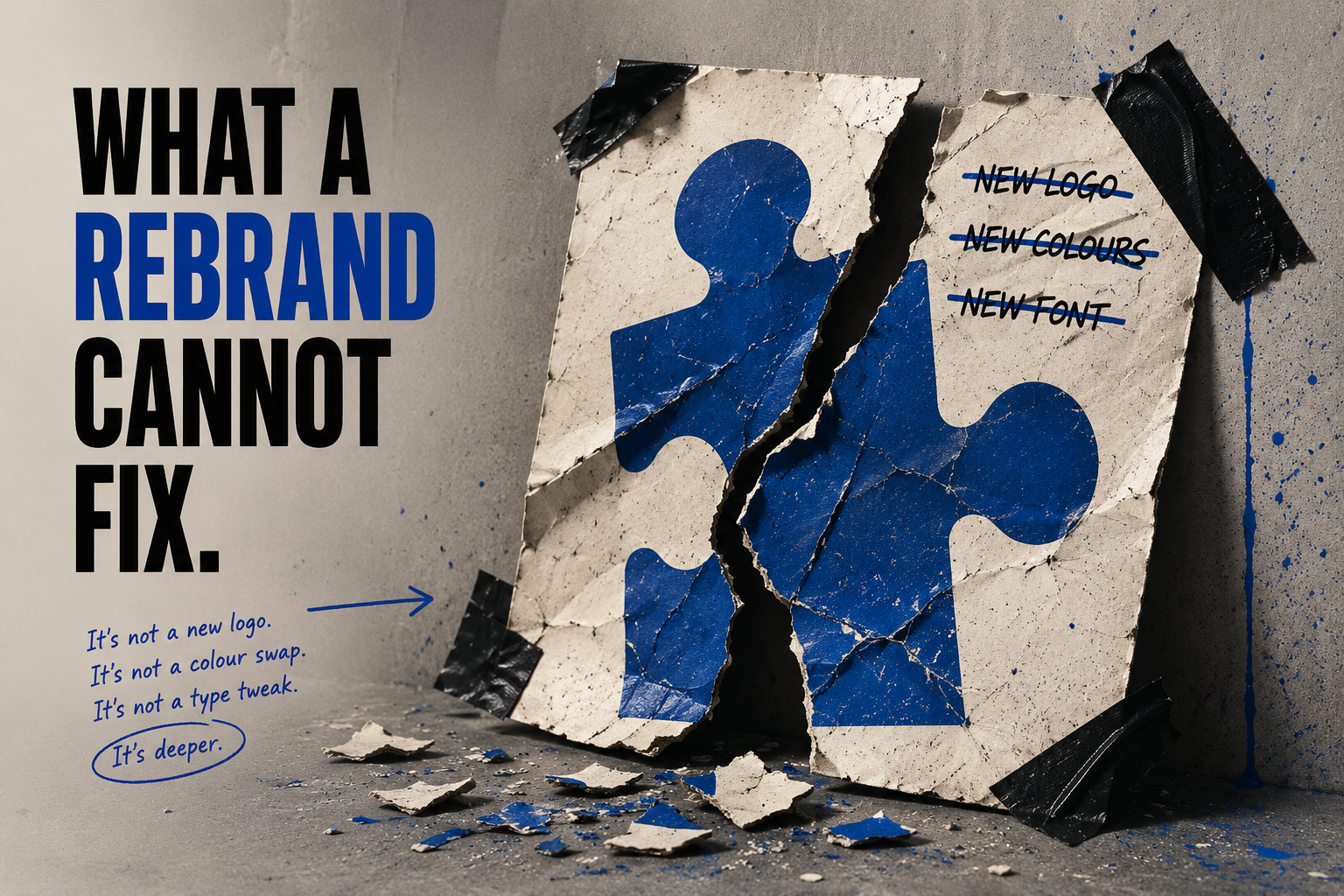
We turn down rebrands. Not often, but reliably in one situation: when the stated problem is positioning and the actual problem is that nobody can tell what the product does from using it.
That distinction sounds pedantic until you have watched a company spend two quarters and a significant budget making an unclear message louder.
Identity work is amplification
A brand identity does not create meaning. It takes meaning that already exists and makes it consistent, recognisable and repeatable. That is genuinely valuable, and it is most of what brand identity work is for.
But amplification is indifferent to what it is amplifying. If the message is unclear, you get a louder unclear message, delivered with more confidence and better typography. Confidence attached to confusion is worse than confusion on its own, because it removes the visible signal that something is wrong.
The diagnostic question
It is unglamorous: can three people who use the product describe what it does in one sentence, and do those sentences agree?
Ask three customers, not three colleagues. Colleagues share vocabulary that customers do not have, which is exactly the failure you are testing for. Write the sentences down verbatim, before comparing them, and resist the urge to help.
If the sentences agree
You have a real message and an expression problem. The work is making that message land faster, look like itself everywhere, and stop being reinvented by whoever is building the next deck. This is a good rebrand, and it will do what the brief says it will.
If the sentences disagree
Then the work is positioning and product clarity, and the visual identity should wait until there is something settled to express. Doing it in the other order commits an unclear message to a system whose entire purpose is to repeat it faithfully for years.
This is usually the cheaper diagnosis of the two, which is a good reason to make it before anybody opens a design tool.
What a rebrand genuinely does fix
Worth being precise here, because “rebrands do not fix things” is as wrong as the opposite. An identity reliably fixes inconsistency, and inconsistency is a real cost: sales decks that contradict the website, five versions of the logo in circulation, a colour that means something different in every channel.
It fixes the legibility of a message that already exists but is being expressed badly. It fixes a look that no longer matches the price, the ambition or the audience. And it fixes the internal problem of nobody knowing what “on brand” means, which quietly slows down every piece of work a company produces.
What it does not fix is a product nobody can explain, a proposition aimed at two audiences at once, or a business that has not yet decided what it is choosing not to do.
Sequencing, not refusal
None of this is an argument against rebrands. It is an argument for sequencing: positioning, then expression, then application — in that order, with the first settled enough that the second is not quietly guessing.
The studios producing identity work with real staying power are usually the ones that insisted on getting the sentence right first. It is also why the brief matters more than the deliverable: a rebrand brief that names the decision rather than the artefact tends to produce a better artefact.
Common misconceptions
That a rebrand will fix a growth problem. It can remove friction from an existing demand; it cannot manufacture demand that was not there.
That a refresh is the safe middle option. A refresh applied to an unclear message produces a slightly nicer unclear message, at a cost not far below doing the whole thing properly.
That the audience will notice. Internally a rebrand is enormous. Externally, most customers register that something changed and then return to whatever they came for. That is not an argument against doing it — it is an argument for spending the effort where it changes their experience rather than where it changes yours.